
Ultrasonic Heating and Measurement.
For Industrial Polymer Processing.
A fundamentally different way to heat, measure and control polymer processes.
FERVONIC
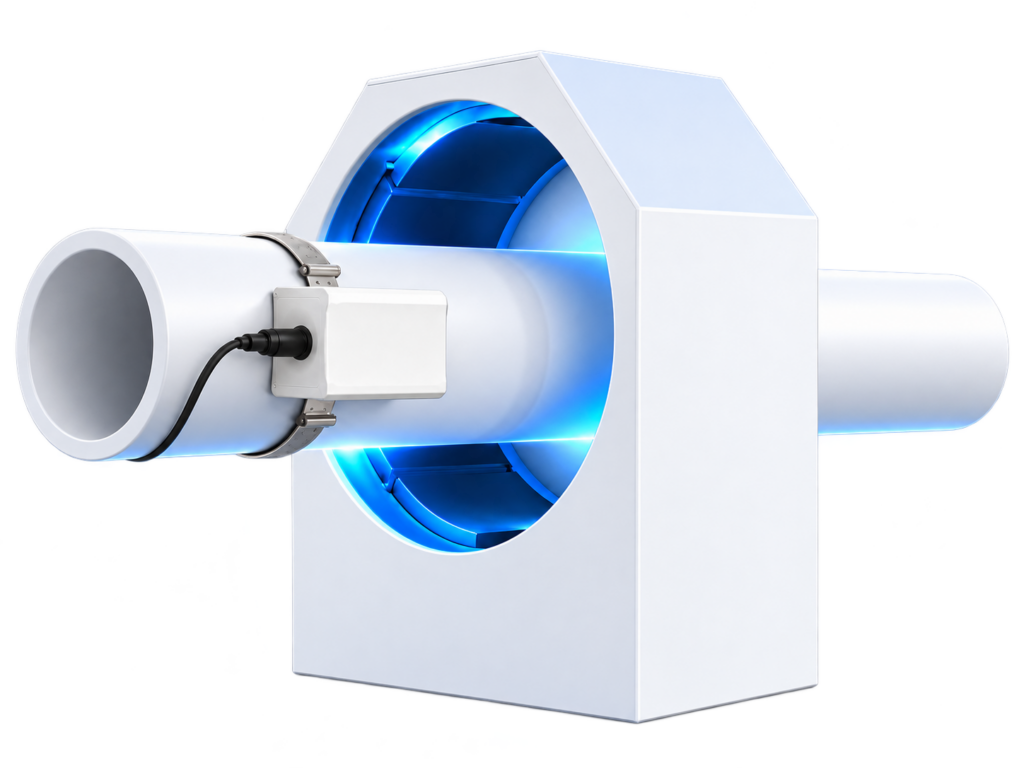
Heating a thick piece of polymer is surprisingly difficult.
Most conventional heating methods heat the surface first. But polymers conduct heat poorly, so it can take a long time before the center reaches the required temperature.
For thin products, this can be manageable. But as wall thickness increases, the distance the heat must travel becomes larger and the process becomes increasingly slow and difficult to control. The surface can already be hot while the core is still cold.
This creates several challenges:
Long heating times. The process must wait for heat to penetrate through the material.
Temperature gradients. The outside and inside of the polymer can be at very different temperatures.
Large process footprints. Long heating times often require extended ovens, infrared sections, or conditioning zones.
High energy consumption. A significant amount of energy is used to maintain the surrounding equipment and compensate for heat losses.
Limited insight into internal temperature. Conventional sensors typically measure the surface or surrounding environment, while the temperature inside the polymer remains largely unknown.
For thick-walled polymer processing, getting the right temperature throughout the material can become one of the main limitations on process speed, footprint, energy efficiency, and control.
What if heat could be generated inside the polymer volume?
Fervonic uses ultrasound to interact directly with the polymer. Instead of relying only on heat transfer from the surface, ultrasonic energy generates heat throughout the polymer volume. The same ultrasound signal provides direct insight into the material’s internal temperature. One technology for faster heating, better measurement, and more precise process control.
HOW IT WORKS
MEASURE:
Measure the internal temperature profile with ultrasound
Ultrasonic signals travel through the polymer. Their propagation changes with material temperature, allowing the internal thermal state to be estimated without placing sensors inside the material.
HEAT:
Generate heat directly within the material
High-intensity ultrasound is converted into heat inside the polymer volume, reducing the dependency on slow surface-to-core thermal conduction.
RE-MEASURE AND CONTROL:
Measure the result and adjust the heating input
The internal temperature is measured again after heating. This creates the basis for controlling the process according to the actual thermal state of the material.
REACH THE TARGET TEMPERATURE:
Create a more controlled temperature distribution throughout the material.
The objective is not simply to make the polymer hotter, but to bring the material toward the temperature profile required by the process.
Why Fervonic
A fundamentally different way to heat, measure and control polymer processes.
By generating heat within the polymer and gaining insight into its internal temperature, Fervonic can overcome limitations that are inherent to conventional surface heating.
Fast
Heat the material up to 100x faster. Run the process faster.
Efficient
Put energy into the material, not the surroundings.
Controlled
Know what is happening inside the material, without damaging the material.
Compact
Achieve more heating performance in less space.
All-electric
Move toward cleaner industrial heating.
Built for processes where temperature matters most.
Where conventional heating and temperature measurement reach their limits, Fervonic creates new process possibilities. Fervonic is particularly valuable in polymer processes where thick sections, low thermal conductivity, limited heating time, tight footprints, or poor visibility into internal temperature constrain performance.
Heat beyond the surface.
Generate heat within the polymer volume instead of relying only on slow conduction from the outside, making it easier to bring thick sections to the required thermal state.
Achieve more heating in less time and space.
Increase the amount of heating that can be delivered within a fixed line length, or reduce the heating-zone footprint required to reach the target temperature.
Create the right thermal state for controlled deformation.
Heat the material more uniformly through its thickness to support processes where temperature strongly affects formability, dimensional control, and process stability.
See what surface sensors cannot.
Use ultrasound to gain insight into temperature inside the polymer, where conventional surface measurements reveal only part of the thermal state.
Turn internal temperature into a control signal.
Use internal temperature information to adjust heating in real time, creating the basis for tighter control, greater consistency, and more automated processing.
The Fervonic Team

Frank van Berlo
CTO

Lydie Smets
CEO

Patrick Anderson
Principal Advisor

Fervonic is a spin-out from the Eindhoven University of Technology, specifically from the Processing and Performance of Materials Group.
Let’s work together
We partner with industrial leaders to redefine thermal processing in high-performance polymer applications through ultrasound heating and sensing. As we scale our technology and market reach, we welcome inquiries from strategic investors and partners interested in the future of sustainable material processing.
Contact us to discuss pilot projects or collaboration opportunities.
Call
+31643049736
Monday – Friday
9:00 – 17:00
Visit
Dominee Theodor Fliednerstraat 2
5631 BN Eindhoven